guide
Fast Track at Tan Son Nhat Airport (SGN)
How fast track works at Ho Chi Minh City's Tan Son Nhat airport, from Terminal 2 international arrivals to departure-side priority lanes.
Tan Son Nhat’s two terminals
Tan Son Nhat serves Ho Chi Minh City, and international flights land and depart through Terminal 2, while a newer Terminal 3 now handles domestic traffic. If your itinerary includes a domestic connection, understand upfront that arriving internationally and continuing domestically means crossing between two separate buildings — one more reason an escort who already knows the layout can save real confusion on a first visit.
Arriving through Tan Son Nhat with an escort
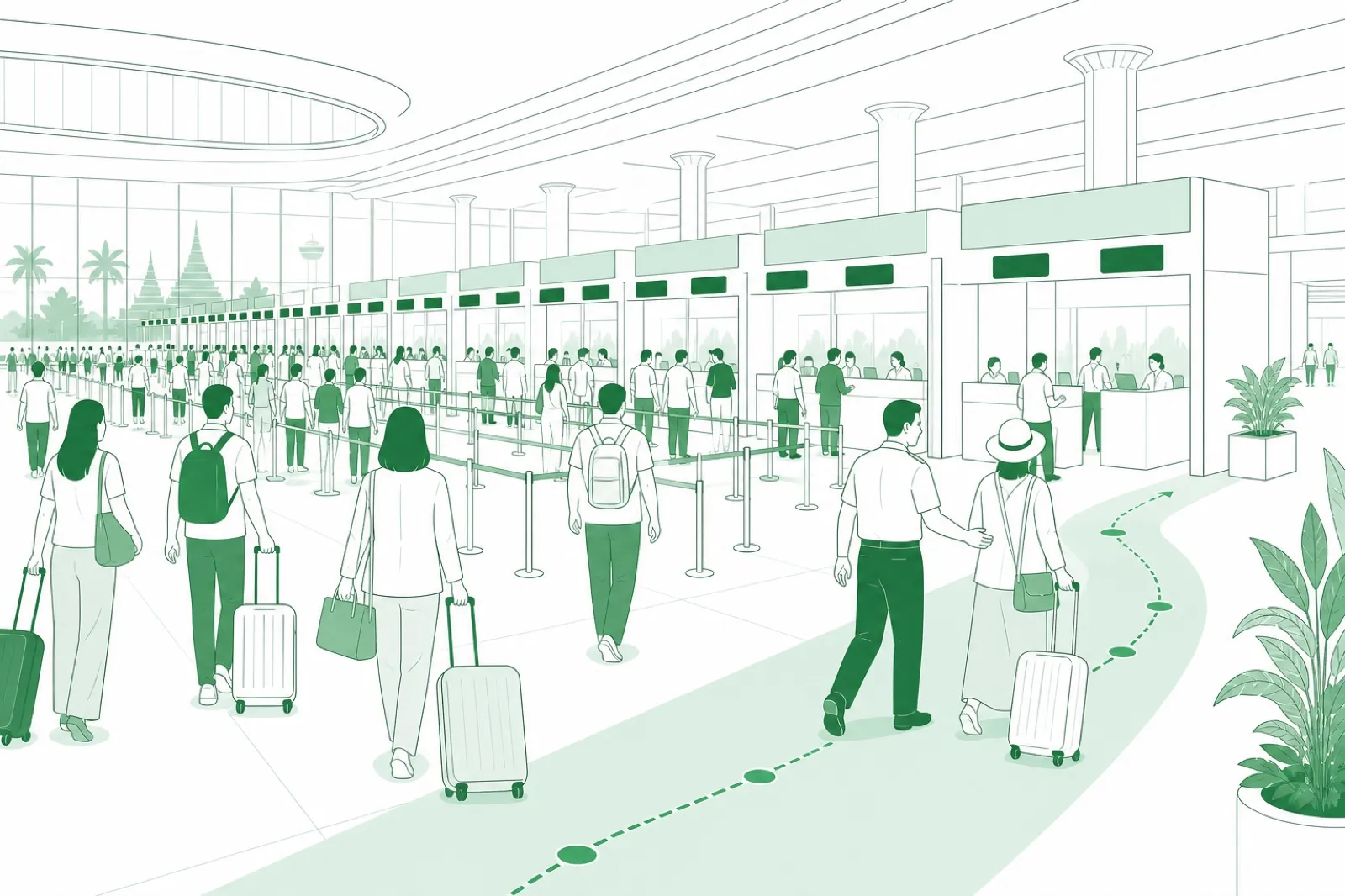
An assistant typically meets arriving passengers at the aircraft door or jet bridge, before the walk into Terminal 2’s arrivals hall even begins. From there the role is to guide you toward a shorter immigration lane rather than the general one, stay with you through the officer’s check — where you present your own documents and the officer alone decides — and continue with you to baggage reclaim and customs. Terminal 2 can get crowded when several wide-body flights land close together, and that’s exactly the situation where being guided rather than self-navigating tends to matter most.
Departing through Tan Son Nhat
On the outbound side, the same idea runs kerb to gate: meeting at drop-off or check-in, moving through to a security lane, and on to passport control before a final handover close to the gate. Every checkpoint is still staffed by the same official process every other departing passenger goes through — nothing about the sequence itself changes, only how much of the finding-your-way is done for you.
When Tan Son Nhat gets busiest
Ho Chi Minh City is Vietnam’s largest hub for international arrivals, and queues at Tan Son Nhat tend to swell around flight banks — clusters of wide-body arrivals landing within a short window of each other, often in the evening. Holiday periods add another layer on top of the everyday pattern. None of this is unique to Tan Son Nhat; the Hanoi vs Saigon arrival comparison page walks through how the two hubs actually differ in practice.
Baggage and customs after immigration
Once you clear passport control, the walk to baggage reclaim in Terminal 2 is usually a shorter stretch, though which belt serves your flight is only confirmed once the screens update after landing — an escort who already knows the arrivals hall layout can save the search-and-guess that first-time visitors often go through. From there, Vietnam’s ordinary green and red customs channels apply to every arriving passenger: nothing to declare within the standard allowances means the green channel, where spot checks happen only from time to time, while anything requiring declaration means the red channel and a longer stop. No escort changes which channel applies to you or what customs decides to check.
Crossing to the domestic side
Terminal 3 sits apart from Terminal 2 physically, and a same-day connection from an international arrival to a domestic departure means clearing that gap on top of everything else — kerb transfer, re-entering security, and finding a different check-in area entirely. It’s one of the more common ways a Tan Son Nhat connection runs tighter than travellers expect, particularly if the international leg lands late relative to the domestic one.
Is it worth arranging here
Given how much of Tan Son Nhat’s congestion is timing-driven, the calculus tends to favour fast track more here than at a quieter regional airport — particularly for red-eye landings, short connections, or a first visit to a terminal this size. The general Vietnam fast track guide covers how the process works nationwide, and the dedicated is it worth it page breaks the trade-off down by situation rather than by airport.