guide
Fast Track vs VIP Terminal in Vietnam
Fast track, CIP/VIP terminal packages and airline priority lanes sound alike but are different services - here is how to tell them apart before booking.
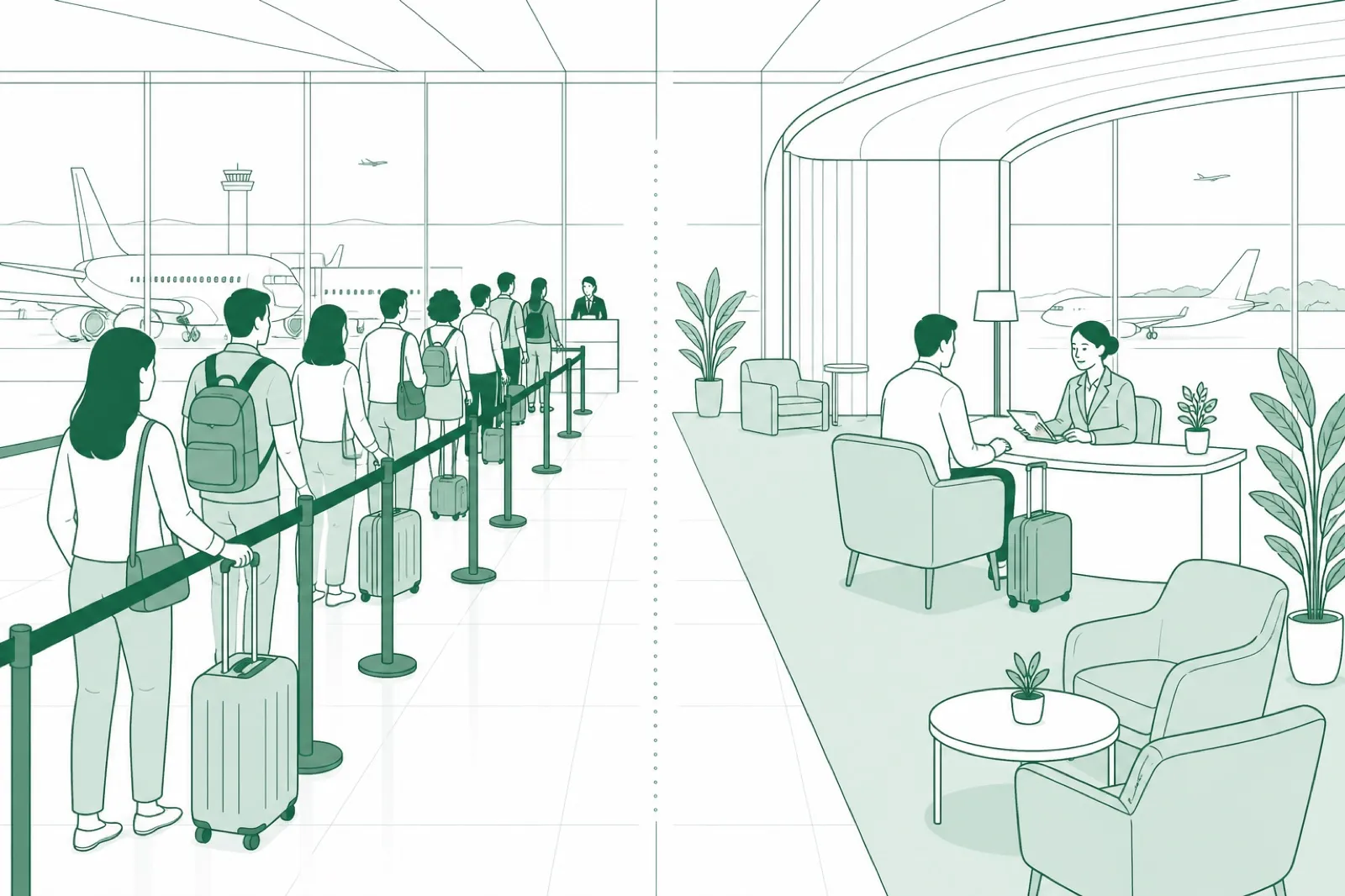
Three different things at a Vietnamese airport all get called some version of “skip the line,” and travellers routinely book the wrong one because the marketing language overlaps far more than the services do. Here is what each term actually means.
Fast track: an escort through the standard process
Fast track is a person - an assistant who meets you at the gate or the kerb and walks with you through immigration, baggage, customs, security or check-in, generally directing you toward whichever lane is currently moving fastest. It does not involve a separate lounge, and it does not change what happens at any checkpoint: the same officers make the same decisions about the same documents, for every traveller, escorted or not. What fast track buys is navigation and queue position, nothing structural about the checkpoint itself.
CIP or VIP terminal: a separate building, then the same checkpoints
A CIP (Commercially Important Person) or VIP terminal service is a different kind of product entirely. At several Vietnamese international airports there is a dedicated, smaller terminal building or lounge, separate from the main hall, where passengers using the service wait in private facilities rather than in the public terminal. Immigration and customs officers typically process CIP passengers in a designated area of that private space rather than in the main hall - but they are the same official process, run by the same government officers, checking the same documents, arriving at the same decisions. A CIP package buys comfort and privacy in a nicer room; it does not buy a different outcome from the checkpoint, and no legitimate service can offer one.
Airline priority: a queue benefit tied to your ticket or status
Airline priority is narrower still. Business class tickets, elite frequent-flyer tiers, or specific fare classes often come with priority lanes at check-in and sometimes at security, provided by the airline rather than by any third-party assistance company. It typically covers only the stages the airline controls directly - check-in and, at some airports, a security lane - and does not extend to immigration or customs, which sit outside any airline’s authority. It also isn’t something you can book separately from your ticket; it comes bundled with the fare or status you already hold, or it doesn’t apply.
Where the three overlap, and where they genuinely don’t
| Fast track | CIP / VIP terminal | Airline priority | |
|---|---|---|---|
| What it is | An escort through standard checkpoints | A separate terminal or lounge space | A queue benefit from your ticket/status |
| Who provides it | An independent assistance company | The airport or a dedicated CIP operator | Your airline |
| Covers immigration/customs | Yes, as an escort | Yes, processed in a private area | No |
| Changes the officer’s decision | No | No | No |
| Bookable on its own | Yes, per trip | Yes, usually per trip | No, tied to ticket/status |
The row that matters most is the fourth one. None of these three services changes what an immigration or customs officer decides about your documents - that authority sits with the officer alone in every case, full stop. What differs between them is entirely about comfort, space, and how much of the queuing you skip navigating yourself.
How to decide which one fits your trip
If the goal is simply moving through checkpoints without getting lost or losing time in a busy queue, fast track alone usually covers it at a fraction of the complexity of a full terminal package. If the goal is a quiet space to wait, away from a crowded hall, before or after a long flight, a CIP or VIP terminal service is built for that and fast track is not a substitute. And if your ticket or status already includes airline priority, check what it actually covers before assuming it extends to immigration - for most travellers it won’t, which is exactly the gap an escorted arrival or departure is built to fill.