guide
Vietnam Departure Fast Track Explained
How an escorted departure works at Vietnamese airports - kerb to check-in, through security and passport control, and where it helps most.
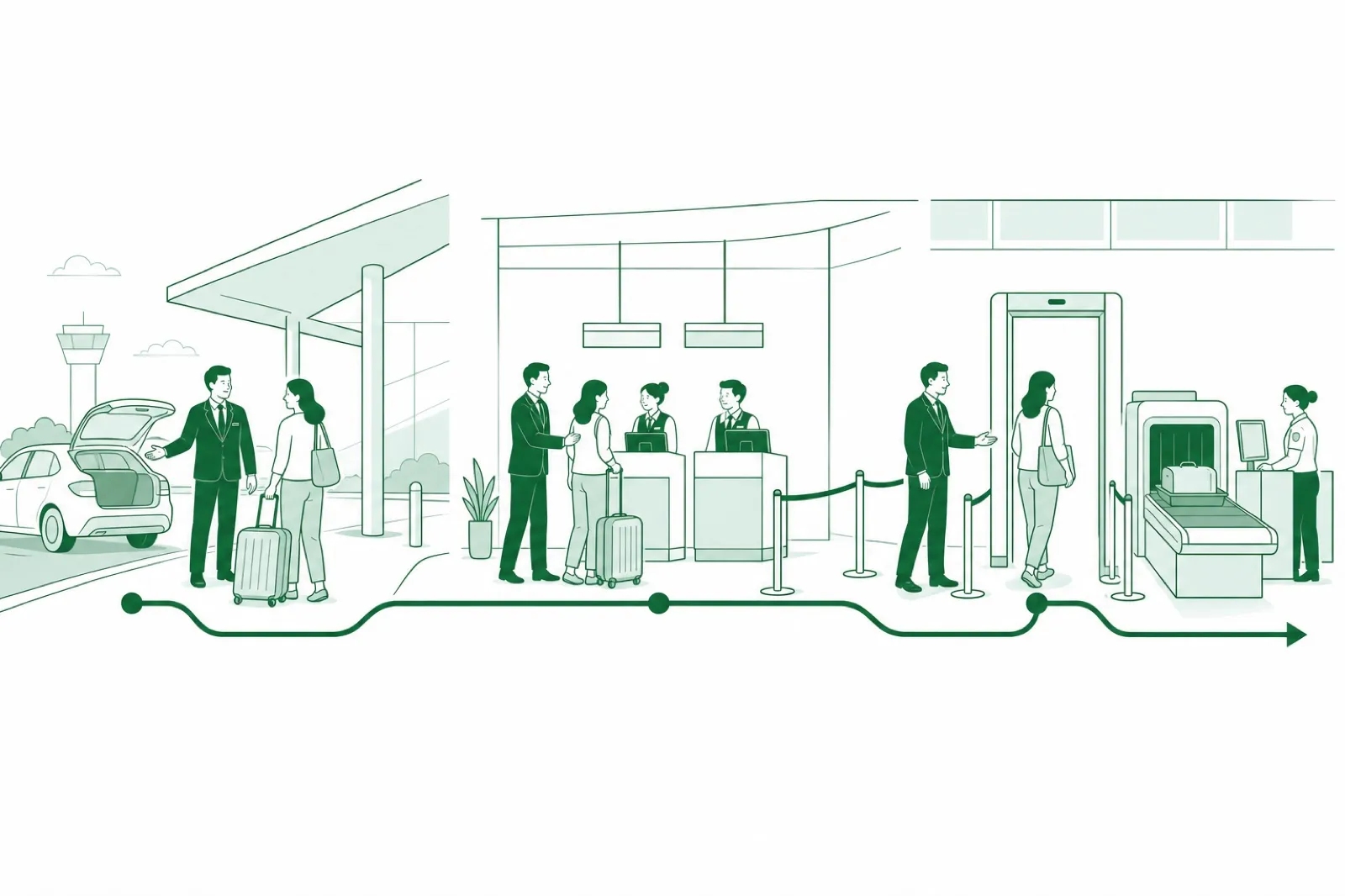
Departure gets less attention than arrival in most airport writing, which is odd, because a missed flight out is a worse day than a slow queue coming in. The departure sequence has its own bottlenecks, and they don’t line up with arrival’s.
The sequence, stage by stage
| Stage | What happens for every traveller | What an escort changes |
|---|---|---|
| Kerb | Bags come out of the vehicle, terminal entry point found | Met at the car, bags handled from the first step |
| Check-in | Airline agent issues boarding pass, checks bags | Directed to the right counter or a priority line where one exists |
| Security | Bags scanned, standard screening for every passenger | Walked to the fastest-moving lane; screening itself is unchanged |
| Passport control | Officer reviews documents, makes the decision | Priority lane where available; the officer’s decision is still theirs alone |
Nothing in that right-hand column skips a stage on the left. An escort moves you through the same checkpoints everyone else passes through, faster in terms of navigation and queue position, not faster in terms of what any individual check involves.
The kerb and check-in, where most of the real time is lost
Departure delays rarely start at security - they start earlier, at a kerb clogged with drop-off traffic or a check-in hall running behind because several flights are closing counters at once. An assistant waiting at the kerb removes the first source of friction: bags are handled immediately, and you’re walked straight to the counter for your specific flight rather than reading an unfamiliar departures board under time pressure. Airline check-in cutoffs are set by the airline, not by any assistance service, and they are worth confirming directly with your airline before you travel - no escort can extend one.
Security and passport control
Security screening is uniform - the same scanners, the same rules on liquids and electronics, applied to every passenger regardless of how they arrived at the checkpoint. Where an escort earns its keep is in getting you to whichever lane is currently moving fastest, and in not letting you end up in the slowest one by chance. Passport control on the way out works the same way it does on the way in: your own documents, presented to your own officer, who decides everything at that counter. Have any required entry-and-exit paperwork sorted well in advance through official government channels - that preparation matters more to how smoothly this stage goes than anything an escort can do once you’re standing in line.
When departure-side queues get worst
Departure halls fill up around the same clustered patterns that shape arrival queues - a run of long-haul flights closing check-in within the same window, a holiday period compressing travel into a shorter stretch than usual, an evening bank heading out to the Middle East or Europe. Checking which hours run heaviest at your specific airport before you book your onward transport to the airport is a cheap way to avoid discovering the answer the hard way, standing in a check-in line watching the clock.
Where this matters most
A slow queue on arrival mostly costs you patience. A slow queue on departure can cost you the flight. That asymmetry is why travellers with a short international connection or a fixed onward departure time tend to be the ones who get the most practical value from an escorted departure - not because the airport treats them differently, but because for them, the margin for a clustered queue eating into the schedule is thinner to begin with. For a routine departure with hours of buffer, the same service is simply a more comfortable way to get through checkpoints you’d clear either way.